

An order that lands $150 short of a vendor’s free freight minimum pays the shipping anyway. Nobody decides to pay it. It just happens, because whoever built the order didn’t know exactly where the line was, and that freight comes straight out of margin on parts that are already thin.
Master cartons cost a shop the same way, only quieter. The products a shop goes through week after week are often cheaper by the case, and a part bought loose instead of by the carton costs more on every unit. You won’t notice it on any one order, but you buy those same items over and over.
Most shops handle both from memory, a sticky note, or a vendor rep’s reminder. Whoever builds the PO has to know each vendor’s minimum, each product’s case quantity and case price, and do the math by hand. And when the order comes up short of free freight, closing the gap usually means guessing what to add. Guess wrong and you’ve paid for shelf stock you didn’t need.
Shops kept telling me some version of that story. They either missed free freight by a little, or they padded the order with the wrong things to get there. So purchase orders in 1sixty8 Manifold now carry the vendor’s terms themselves. That knowledge isn’t locked in one buyer’s head anymore, and the right price shows up no matter who builds the order.
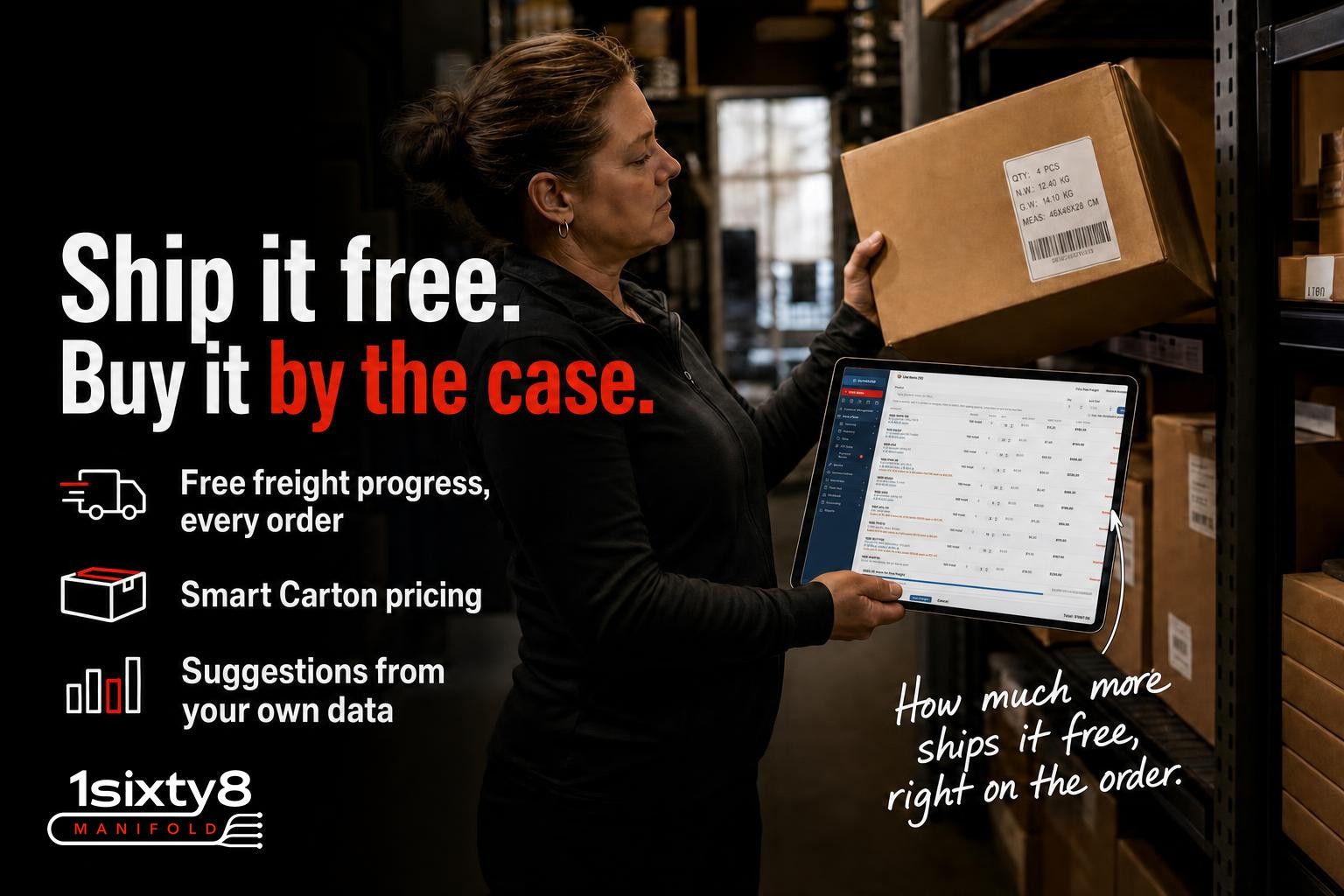
You set a vendor’s free freight total once. From then on, a bar on the PO shows exactly how much more ships it free as you add lines, and draft orders in the list show their distance to free freight at a glance, so you can see which vendor is close before you even open one.
When you’re short, Fill to Free Freight suggests what to add in one click. I wanted those suggestions to come from your shop’s own data and not from what the vendor would like to sell you, so it starts with items that are below their stocking level, then items that have actually sold recently, and it shows the reason next to each one.
Master cartons price themselves too. Give a product its carton quantity and carton cost, and full cartons go on the order at the carton price while any loose units follow that vendor’s partial carton rule. It reads as one clean line, with the split printed underneath on the PO the vendor receives. A few other things come with it:
- When a line is a few units short of a full carton, the PO tells you how many more it takes and what each unit would cost.
- When finishing the cartons already on the order would close the free freight gap, it offers to round those lines up in one click. That’s often the cheapest way to free shipping.
- Each vendor gets its own rules: master cartons off, suggested, or required before an order is submitted, its own rule for billing a broken case, and a freight note like “prepaid at $2,500, ground only.”
Nobody has to type case quantities and case costs for hundreds of parts, either. Master carton quantity and cost columns on a vendor’s price sheet are recognized when you import the sheet.
The buyer stays in charge through all of it. A cost typed by hand is kept and never re-priced, and drafts always save. 1sixty8 Manifold builds the order, and you print it or email it to the vendor.
If your shop has been paying freight it didn’t need to, I’d be glad to show you how this works with your own vendors. Send me a note.