

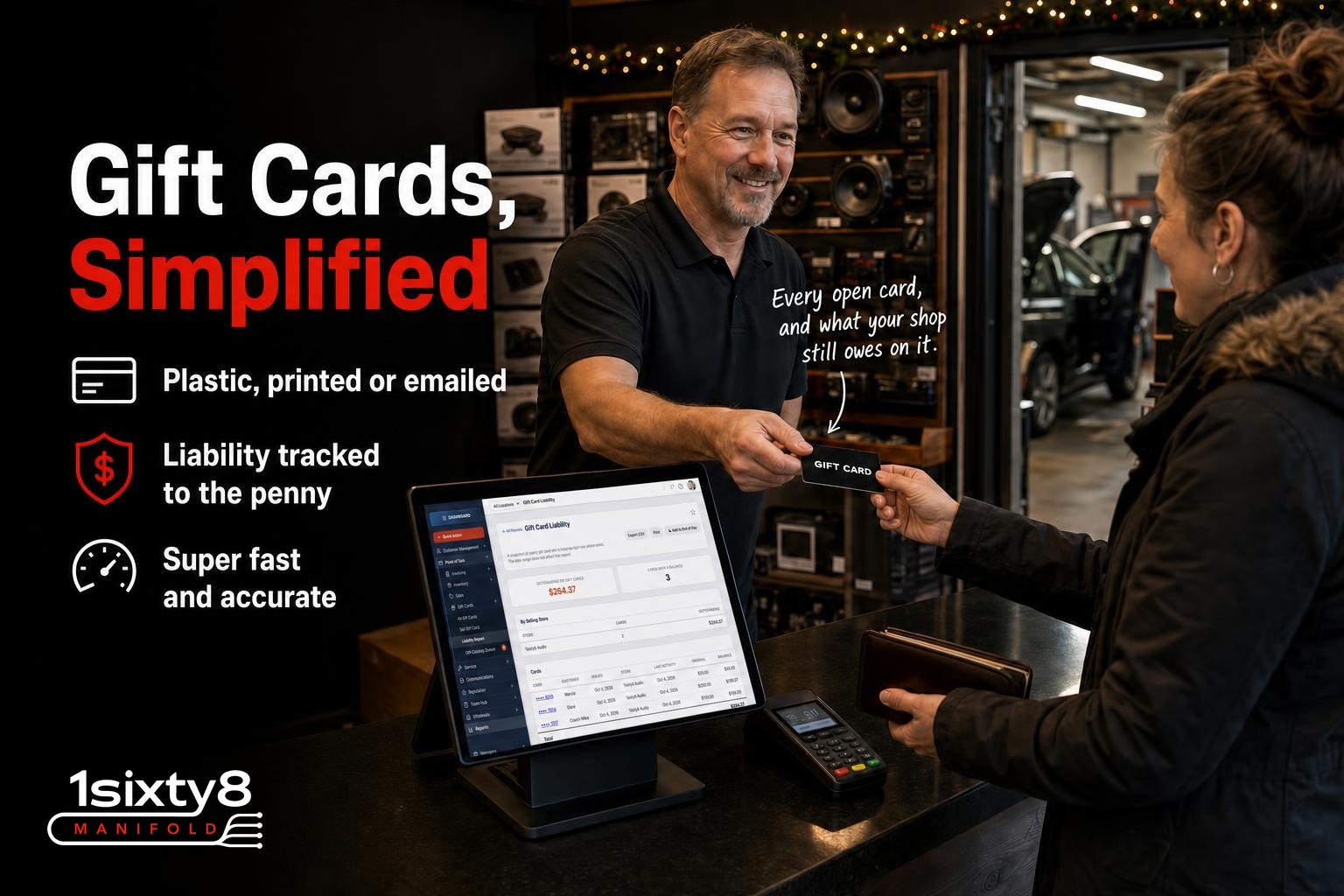
Remote starts, dash cams, speaker upgrades and tint all make great gifts, but often, customers have no idea what that special someone really wants. If your shop has no gift card to sell them, that sale goes somewhere else. If you do sell them, there’s a decent chance they’re tracked on paper and in a spreadsheet somebody has to remember to keep up.
Now every shop running 1sixty8 Manifold has a full gift card program built into the point of sale. It’s part of the Point of Sale module and it comes at no additional cost.
Shops asked me for this, and I wanted it to be part of the system they already run every day rather than something bolted onto the side. A lot of shops get their gift cards through a processor program or a separate provider, which means more fees, another contract and another login. In 1sixty8 Manifold the shop owns its program and the balances live in its own account.
The part I’d ask any owner to think about is the books. Many point of sale systems count a gift card as a sale the day it’s sold. It isn’t one yet. Until somebody spends that card, the money is a debt your shop owes. Count it as a sale and December looks bigger than it really was, and commissions and spiffs get figured on work nobody has done. 1sixty8 Manifold treats a sold card as money owed. A liability report shows exactly how much gift card value is out there, an activity report shows the day-by-day movement, and the daily close puts gift card activity on its own lines.
That doesn’t make gift cards a bad deal. Quite the opposite. The cash comes in before the work does, and the person who gets the card is often a customer who might never have walked through your door, and who often spends more than the card was worth.
You can run it with whatever kind of card suits your shop:
- Your own branded plastic cards, barcode or magnetic stripe, from any printer (there’s a free printing spec sheet you can hand your printer)
- A gift certificate printed on demand
- An e-gift card sent by email
Selling or reloading a card takes seconds at the counter, with an optional To, From and Message. Redeeming one works like any other payment: the balance comes off automatically and the receipt shows what’s left. You can look up a balance anywhere, including from the mobile app with a camera scan. Cards can be tied to a customer, so if one gets lost the balance moves to a new card in one step. Managers handle adjustments, voids and cash-outs, and every change is logged with a reason.
Cards never expire and carry no fees. Gift card rules vary by state, so the program doesn’t turn on until the owner confirms they’ve checked their state’s rules, and it starts from conservative defaults: no expiration, no fees, cash-out on request and a cap per card. Knowing your own state’s rules is still on you.
The last piece matters if you’re thinking about moving. In 29 years I never switched point of sale software once, so I know how many things stand in the way, and the cards already sitting in your customers’ wallets are easy to forget until the day they matter. Open cards from your old system come across with their balances. One multi-store shop switching this month is bringing over 155 open cards worth about $8,500, and those cards will keep working at the counter from day one. If you’re moving one store at a time, every card can be brought up to date at cutover.
If gift cards at your shop still live on paper heading into the holidays, send me a note and I’ll show you how this works.